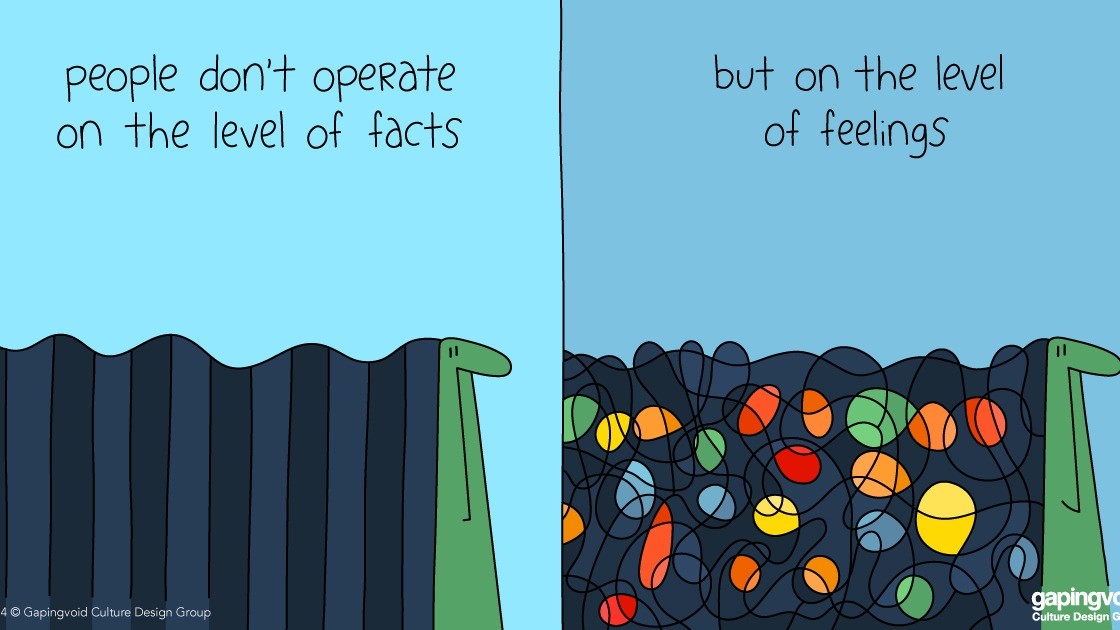
Our beliefs drive our actions — sometimes they protect us, sometimes they hold us back.
The roots of bias
In the 1950s, economist and cognitive scientist Herbert Simon challenged the long-held idea that humans are perfectly rational decision-makers.
He proposed that we operate with bounded rationality — we make decisions with limited time, information, and mental energy.
Rather than calculating every possible outcome, we rely on shortcuts — “good enough” rules that let us act quickly and survive in complex environments.
Building on Simon’s work, psychologists Daniel Kahneman and Amos Tversky went a step further in the 1970s. Through a series of elegant experiments, they showed how these shortcuts — or heuristics — often lead to predictable patterns of distortion in judgment, which they called cognitive biases.
Their research revealed that the brain runs on two systems:
System 1 – fast, intuitive, emotional.
System 2 – slow, deliberate, analytical.
Biases occur when System 1 takes over — filtering decisions through experience and emotion rather than objective analysis.
It’s not that we’re irrational; we’re simply wired for efficiency.
Later, psychologists like Gerd Gigerenzer reframed this further, arguing that many of these “biases” are not flaws at all but adaptive heuristics — efficient mental strategies that help us function effectively in uncertain environments.
Not all biases are bad
So are cognitive biases always errors in judgment?
Not necessarily.
At their core, biases come from heuristics — the fast, intuitive rules our brains use to simplify complex decisions.
These heuristics exist because they work more often than not. They help us navigate uncertainty, reduce cognitive load, and act when perfection isn’t possible. Examples are:
The Availability heuristic helps us gauge risk by recalling vivid examples — it becomes a bias when we mistake what’s memorable for what’s likely.
The Representativeness heuristic helps us spot patterns quickly — it becomes a bias when we overlook evidence that doesn’t fit the pattern.
The Anchoring heuristic gives us a reference point in ambiguity — it becomes a bias when we cling to that anchor despite new information.
In that sense, heuristics are functional — they keep us moving. But when we apply them out of context, or use them to defend rather than decide, they stop helping and start distorting.
Heuristics can become biases when we use them unconsciously without regard to context or protectively. What begins as efficiency turns into defence.
In the context of bias, that means the heuristics that once served us well — the quick judgments and learned patterns that kept us safe or successful — can become liabilities in a changing world.
The environment shifts, but our shortcuts don’t always keep up.
What was once an efficient rule of thumb can quietly harden into a bias — an automatic way of thinking that no longer fits the reality we face.
The same applies to our thinking. When we resist updating our mental shortcuts, we risk leading from an outdated map.
“If you don’t like change, you’re going to like irrelevance even less.”
The very thinking that helped us survive yesterday can be what stops us growing tomorrow. This is why awareness matters. Not to erase bias, but to update our heuristics — to choose consciously which shortcuts still serve us, and which need to be retired.
The paradox of bias
Some biases serve us well in leadership — giving us speed, confidence, and cohesion. Others protect us — by avoiding threat, conflict, or uncertainty.
Table 1: Example of Heuristics becoming biases
The goal isn’t to eliminate bias — that’s impossible.
The goal is to recognise it, understand why it shows up, and decide when it helps and when it hinders.
From cognition to motivation
Researchers like Ziva Kunda and Claude Steele showed that reasoning is often motivated — we interpret information in ways that protect our sense of self.
Others protect our belonging — “If I fit in, I’m safe.”
Constructive biases express security — “I can learn, contribute, and still be safe.”
So bias isn’t just a glitch in logic.
It’s a mirror of motivation— showing what we value, and often, what we fear.
The LSI bridge — from judgement to awareness
This is where the Life Styles Inventory (LSI) adds practical insight. The LSI isn’t a test of right or wrong thinking. It’s an awareness tool, not a judgement tool. It helps people identify their thinking and behavioural styles, which are really motivational patterns — the ways we try to create safety, significance, and value.
Through that lens, we can see bias in motion:
Aggressive-Defensive styles often drive proving biases — over-reliance on being right, strong, seen as a winner or perfect.
Passive-Defensive styles often drive belonging biases — the need to please, conform, be accepted or avoid blame.
The LSI helps leaders move from unconscious protection to conscious choice. It doesn’t “fix” bias — it reveals it, contextualises it, and helps people manage it wisely. To learn more about the LSI, visit our LSI interactive Circumplex here.
From insecurity to integrity
Most people don’t use defensive thinking because they’re bad — they use them to stay safe. But that safety is often psychological, not practical. (In fact, defensive styles aren’t ‘bad’ at all; they’re simply less effective in most contexts).
The real work of leadership is to make the unconscious conscious — to see where bias serves us and where it limits us, and to choose awareness over autopilot.
As Amy Edmondson’s research on psychological safety shows, people only learn and grow when they feel secure enough to suspend self-protection.
When someone says, “You’re biased…”
It’s easy to react defensively — to deny, debate, or justify. But that reaction usually just proves the point.
A more constructive first step is to pause and ask:
“That’s possible. Can you help me see what you’re noticing?”
Bias, by definition, is unconscious until it’s surfaced — and it often takes someone else’s perspective to reveal it. The goal isn’t to feel accused; it’s to feel curious.
But what happens next?
These days, the word “bias” is often used as a conversation stopper rather than a conversation starter. Often, the accusation comes from frustration or difference, not evidence.
So how do we turn that moment into insight for both sides? Here’s how a Constructive thinker might handle that moment — with curiosity, clarity, and calmness.
A pragmatic, constructive sequence
Acknowledge possibility “That’s possible — we all have biases.” This disarms defensiveness and signals openness.
Seek specifics “Can you give me an example of what you’re seeing or what makes it feel that way?” This invites data — moving from accusation to observation.
Explore intent and impact “What impact do you think my perspective or decision is having?” “What assumptions do you think I might be making?” These questions invite the other person to reflect on substance rather than judgment.
Share your reasoning “Here’s how I arrived at that conclusion — what might I be missing?” This models transparency and mutual respect.
Reflect together “Is this really about bias, or could it be a difference in values, priorities, or experience?” This helps both parties move from blame to understanding.
The principle
The goal isn’t to prove who’s biased — it’s to find what’s unseen. Handled with calm curiosity, even a defensive accusation can become a doorway to shared learning.
If both people stay open, what began as confrontation can end in connection.
Your reflection
We all have biases.Some protect us, some propel us, and all can teach us something if we’re willing to look.
Awareness is the first act of leadership.
What you do with it next is the real test.
So here’s a challenge:
· Which bias do you rely on most — and when does it help or hinder you?
· When someone points out your bias, do you defend it, or explore it?
I’d love to hear how you approach moments like this — what helps you stay curious rather than defensive?