Introduction
We talk about psychological safety a lot — and for good reason. It’s one of the strongest predictors of performance, learning, and innovation. Yet for many leaders, the term has lost its edge. It’s often used to mean being nice, avoiding conflict, or making sure no one feels uncomfortable.
Those are good intentions — but they miss the point. True psychological safety isn’t about comfort. It’s about capacity — our nervous system’s capacity to stay connected and engaged even when things get tough.
Psychological safety
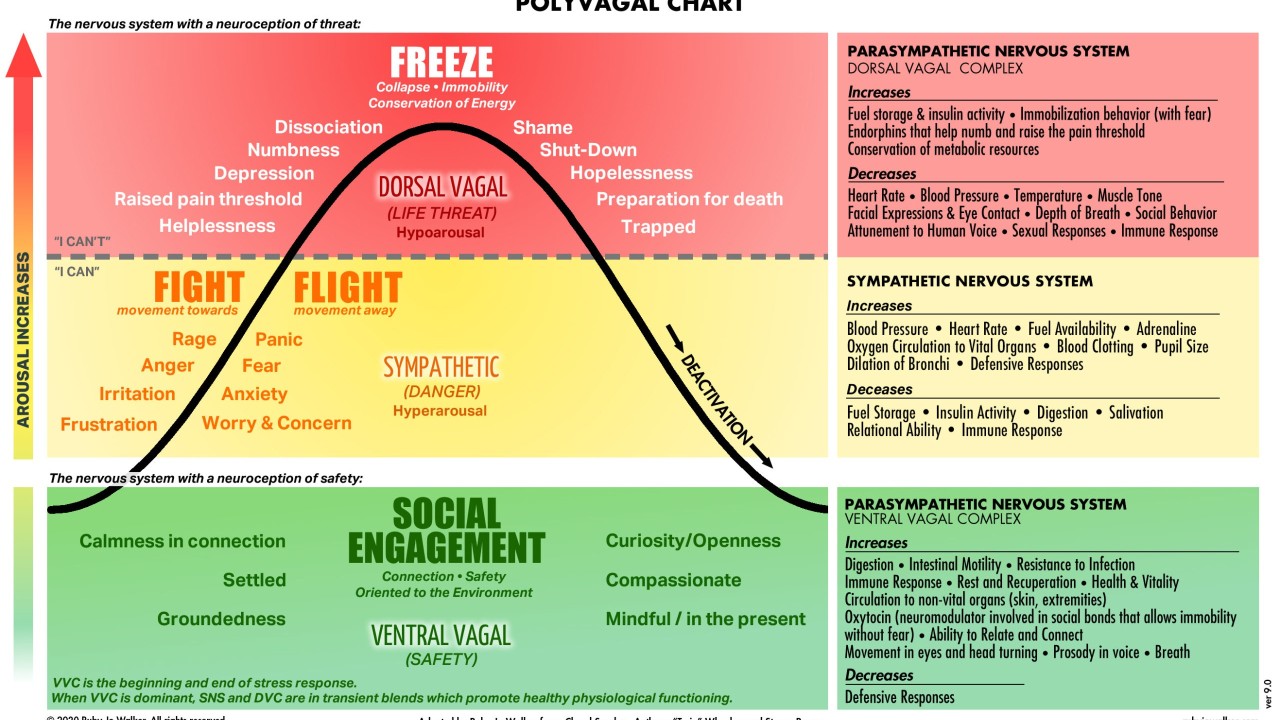
Psychological safety isn’t just a mindset; it’s a physiological state. Drawing on Dr Stephen Porges’ Polyvagal Theory (image above), we now understand that our body has three primary states designed to keep us safe:
- Ventral Vagal (Safe & Connected): calm, curious, and open.
- Sympathetic (Fight or Flight): alert, focused, or defensive.
- Dorsal Vagal (Shutdown): flat, disconnected, or withdrawn.
We move up and down this ladder all day long — sometimes within seconds. When our body senses safety, we stay in ventral mode: we can think clearly, listen well, and connect authentically (social engagement).
When it senses threat, we move into defence: we argue, control, or avoid (Fight or Flight). And when we get to a state of feeling hopelessness we can shut down (Freeze).
Many people assume fight, flight, and freeze are the same thing. They’re not.
Fight and flight are states of hyper-arousal— the body gearing up for action.
Freeze is hypo-arousal— the body shutting down to conserve energy.
Each has very different consequences for thinking, emotion, and connection.
So, psychological safety exists when people can stay — or return — to the Ventral Vaga state even under pressure.
What Psychological Safety Is
- A shared sense of felt safety that keeps people engaged even in discomfort.
- A biological foundation for trust and learning — not just a team norm.
- A relational experience built through empathy, presence, and inclusion.
- The condition where people can take risks and challenge ideas without triggering defence — in themselves or others.
What Psychological Safety Isn’t
- It’s not the absence of conflict — real safety allows disagreement without disconnection.
- It’s not Endless comfort — safety helps us stretch without breaking.
- It’s not Being “nice” — it’s about being real and respectful, not avoiding truth.
- It’s not Static — it rises and falls with context, tone, and trust.
Leadership and the Nervous System
Leaders shape psychological safety not only through what they say, but through how their nervous system shows up.
Tone, timing, and presence all send cues of safety or threat.
A calm, grounded leader regulates others; an anxious or detached one pulls people into defence. The work of leading safe teams begins with self-regulation — noticing your own state and learning to reset it.
Linking to the Thrive Framework
In our Thrive Programme, psychological safety is the climate condition that allows constructive thinking to flourish — the invisible bridge between physiology and performance.
When people feel safe, they think better, relate better, and perform better. Their nervous system stays open, not defensive.
Our Stress Processing Report (SPR) helps make this visible — identifying four clusters of thinking styles that shift depending on whether we feel safe or threatened. The table below shows how safety (or its absence) shows up in each cluster.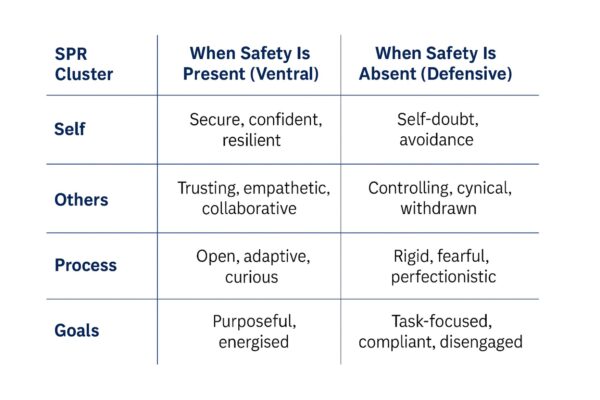
The Takeaway
It’s where care and challenge coexist. Where teams can disagree productively, learn collectively, and keep moving forward — together. Where the body feels safe enough for the mind to stay open.
That’s what it truly means to Thrive under pressure.